
Friendly Fraud vs. Chargeback Fraud in Travel: A Merchant’s Guide to Winning Disputes
Friendly fraud and chargeback fraud describe the same event, a cardholder disputing a purchase they genuinely made, separated by intent.
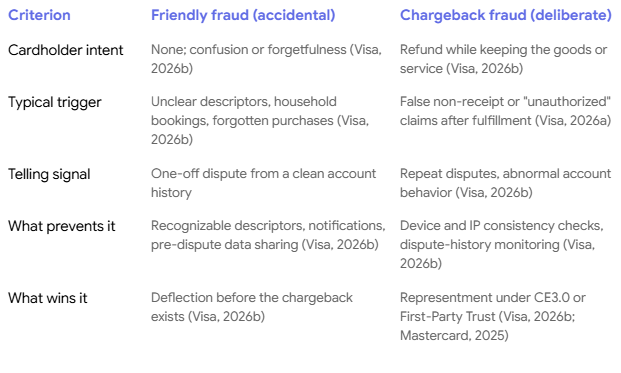
Friendly fraud usually starts as confusion, something like an unrecognized descriptor, a booking made by a spouse, a fare paid six months ago. Chargeback fraud is deliberate: the traveler flies, then disputes the charge to recover the money.
Winning disputes in travel depends on telling the two apart, because each rewards a different response.
Card networks group both under the label first-party misuse, and the terminology drifts even within a single network’s own material. Visa’s chargeback guide treats “friendly fraud” and “chargeback fraud” as synonyms for a customer intentionally reversing a legitimate purchase (Visa, 2026a), while its dedicated friendly fraud page concedes that the behavior “sometimes stems from a misunderstanding” and other times is a deliberate attempt to game the system (Visa, 2026b).
Merchants cannot afford that looseness. A dispute team that sends a confused loyal customer through aggressive representment burns a relationship worth far more than the fare, and a team that quietly refunds a serial abuser trains that abuser to come back.
The volume justifies the effort of drawing the line properly. Mastercard forecasts the global cost of chargebacks to merchants at 42 billion dollars by 2028, with nearly half reported as fraudulent (Mastercard, 2025). In the Merchant Risk Council’s latest global survey of 1,278 payments and fraud professionals across 37 countries, 64% of merchants reported rising first-party misuse, and a quarter of them put the increase at 25% or more (MRC, 2026). Visa’s own figures place first-party misuse at around 20% of all fraudulent disputes globally, climbing to 30% for high-volume online merchants, and name high-value retail and travel among the sectors hit hardest (Visa, 2026b).
Few industries combine four-figure price points, months between payment and fulfillment, and itineraries settled under brand names the traveler never typed into a search box.
How to read the comparison
The criteria below come from the questions a dispute team actually has to answer when a case lands: what did the cardholder intend, what triggered the claim, what in the data reveals it, what would have prevented it, and what wins it.
Τhe six-month memory problem
A travel booking ages badly on a card statement. The traveler pays in March through an online agency, the charge settles under an acquirer descriptor, and in July someone in the household reviews the statement and calls the bank. Visa lists descriptor confusion and household misuse among the most common forms of first-party misuse (Visa, 2026b), and travel’s long lead times give both failure modes room to develop. Multi-segment itineraries make it worse, since a single trip can produce several charges under several names, none of them matching the brand the customer remembers booking with.
Deliberate abuse runs the sequence in reverse. Fulfillment comes first, then the claim. Visa describes the pattern bluntly: the cardholder completes a legitimate transaction, contacts the issuer after fulfillment claiming fraud, and if the merchant cannot produce compelling evidence, the chargeback stands (Visa, 2026b).
A flight, once flown, cannot be returned to inventory, so a lost dispute in travel is a full write-off of both revenue and cost of service, plus the dispute fee.
Α pattern is a verdict
Years of clean bookings followed by a single dispute over a strange descriptor reads as confusion.
Visa’s guidance points merchants toward monitoring accounts for abnormal behavior or multiple disputes and verifying device ID and IP consistency across repeat purchases (Visa, 2026b), and that is exactly where deliberate abuse gives itself away: the same account disputing its third completed trip, a device that changes between booking and claim, dispute timing that tracks the return flight rather than the billing date.
Generic fraud tools that score each transaction in isolation miss this, because the signal lives in the account’s history and in the logistics of the trip itself, not in any single payment.
Prevention and evidence
Confusion cases should never become chargebacks at all. A dispute deflected carries no fee, no hit to the chargeback ratio, and no analyst time, which is why Visa’s guidance concentrates on recognizable billing descriptors, purchase and delivery notifications, and pre-dispute tools that surface order details to the issuer and cardholder before a dispute is filed (Visa, 2026b).
In travel, the test is whether a confirmation still makes sense to a spouse reading a statement half a year after booking.Deliberate abusers are not confused, so clarity does nothing for them.
What works is evidence, and the networks have formalized what counts. Visa’s Compelling Evidence 3.0 lets merchants overturn invalid chargebacks with structured data, requiring at least two prior undisputed transactions with matching IP addresses or device IDs older than 120 days (Visa, 2026b). Mastercard’s First-Party Trust program takes the same route, letting merchants share enhanced data at authorization or during the dispute, with chargeback protection for disputes that meet its data-sharing requirements; after its U.S. launch it has expanded to Canada, Latin America, the Caribbean, and Asia Pacific (Mastercard, 2025).
Both frameworks share an uncomfortable implication for merchants, as the evidence that wins a November dispute has to be captured at booking time in March. Nearly 90% of enterprise merchants already use compelling evidence to challenge invalid disputes, and MRC members doing so report higher win rates and lower loss ratios than non-members (Visa, 2026b).
Where the budget should go
A travel merchant whose disputes cluster around long lead times, family bookings, and descriptor mismatches should spend on deflection first. Statement clarity, timely notifications, and pre-dispute data sharing resolve these cases before they cost anything, and contesting them wins the battle while losing the customer.
A merchant seeing repeat disputers and post-travel “unauthorized” claims should invest in representment discipline instead: continuous capture of device, login, and delivery data in the shape CE3.0 and First-Party Trust convert into liability protection.
Most travel merchants face both patterns at once, and 64% of merchants report the overall problem growing (MRC, 2026).
The practical conclusion is to run dispute management as one intelligence problem. The behavioral context that classifies a dispute also builds the evidence file to fight it, and points to the descriptor or notification gap that would have prevented it. Handled with that discipline, the dispute desk protects margin at the final stage of the conversion funnel instead of merely accounting for what was lost.